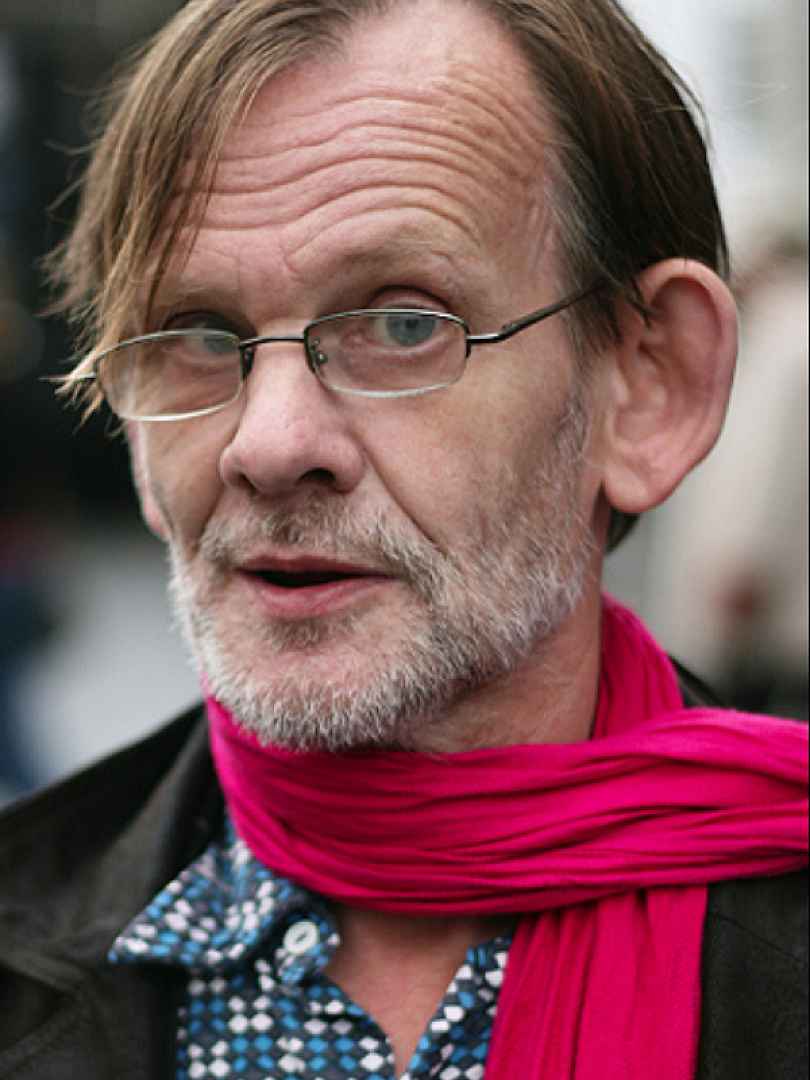
Magnús Þór Jónsson Megas
b. 1945 , d. 2026
Magnús Þór Jónsson was an Icelandic musician, songwriter, author, and visual artist, best known by his stage name Megas.
Megas grew up in the Norðurmýri district of Reykjavík. He attended Austurbæjarskóli before continuing to Menntaskólinn í Reykjavík, where he graduated in 1965. He then worked briefly as a cashier at Landsbankinn before moving to Norway to study ethnology at the University of Oslo.
He began writing songs and lyrics at an early age, studied the piano, and composed, among other works, the song Gamli sorrí Gráni for his confirmation. During his lower secondary school years, he wrote minuets before becoming fascinated by folk music. He purchased a collection of American folk songs and developed a keen interest in Scandinavian folk traditions. Among the greatest influences on the young Megas were Halldór Laxness and Elvis Presley.
While in secondary school, Megas helped paint stage scenery for the centenary production of Útilegumennirnir by Matthías Jochumsson, contributed illustrations to the school magazine, and published several poems and short stories there. He listened to classical music, particularly more challenging repertoire, as well as Bob Dylan, whose work had a profound influence on him. After graduating from secondary school, Megas enrolled at the University of Iceland. There he came across the word Megas in a Greek dictionary and intended to use it as a pen name when one of his short stories was accepted for publication in Lesbók Morgunblaðsins. Although the story ultimately appeared under his real name, he adopted the artist name Megas from that point onward.
At Christmas 1968, he published the book Megas, which contained the songs Dauði Snorra Sturlusonar, Jón Sigurðsson & sjálfstæðisbarátta Íslendinga, Með gati, Ófelía, Ragnheiður biskupsdóttir, Silfur Egils, Um óheppilega fundvísi Ingólfs Arnarsonar, Um skáldið Jónas, Um grimman dauða Jóns Arasonar and Vertu mér samferða inní blómalandið, amma. A second booklet followed shortly thereafter, and in 1973 a third was published under the title Megas kominn, en fráleitt farinn.
Before the release of his first album in Norway in 1972, Megas had already published three booklets containing lyrics, musical notation, and drawings. These were simply titled Megas I (1968), Megas II (1969), and Megas III (1970). In 1973 he republished the three volumes in revised editions and added a fourth, Megas IV. Much of the material first published in these booklets later appeared on his albums.
Among Megas's most popular songs are Spáðu í mig, Tvær stjörnur, Reykjavíkurnætur and Fatlafól. Throughout his career he collaborated with numerous artists, including Bubbi Morthens, Nýdönsk, Spilverk þjóðanna, and KUKL.
Among the honours he received during his lifetime were the Icelandic Artists' Honorary Salary and the Jónas Hallgrímsson Award in recognition of his contribution to the Icelandic language.
Adapted from Wikipedia.
Photograph courtesy of ismus.is; original photograph by Örlygur Hnefill.